PROJECT DETAILS
- Architects: Amit Khanna Design Associates
- Plot Size: 950 Sqm
- Constructed Area: 500 Sqm
- Design Team: Ankita Misra, Krishna Yadav
- Contractor: Build Design Workshop
- Structural Engineer: Spacelink Engineers
- Air Conditioning: Hitachi
- Windows: Schueco
- Bathroom Fixtures: Kohler / Jaquar
- Kitchens: HMP Engineering
- Location: Gurugram
Gurugram’s urban fabric, like many cities, is shaped by zoning regulations. This private villa in Gurugam by Amit Khanna Design Associates creatively responds to these constraints. With a limited footprint, the project cleverly allocates 40% of the plot to a lush garden, challenging conventional norms and redefining spatial design.
Zoning regulations have determined the character of cities for centuries. Ever since the first fire in London, following which the mandates of setting buildings apart came into being (ostensibly to avoid fires spreading from thatched eaves), city planners have championed the use of offsets, or “setbacks”. Quite impossible to implement in densely populated urban centers where land is at a premium, these regulations have nonetheless pervaded the design of suburbia around the world. Gurugram, set southwest of Delhi, is no different.

Land parcels of 500 Sq.Mt. in Gurugram must follow a 4m setback to both the front and rear of buildings and they must further contend with a 7m x 3m linear open space eating into the building footprint that is mirrored to one side with adjacent plots. This has created a built form of narrow driveways with high party walls abutting three storey buildings, canyons of darkness from which most of the building must draw their light and ventilation. These are often usurped by enclosed balcony spaces, covered driveways and every conceivable architectural trick to circumvent the necessity for open space.


The diminutive brief was therefore a blessing in disguise. Tasked with building only 950 Sq.Mt. on a site that would normally have been built out to 1500 Sq.Mt. meant that this private villa in Gurugam could be designed free from the need to conform to the outer setback line mandated by city planners. To this end, an internal brief was created – that 40% of the house must be a garden and 60% of the house must look into it. Hence the name, 40/60 House.
The strategy to meet this internal requirement was to consolidate all the open area requirements into a garden at the south and west of the plot. The built portion was then arranged as a “L” around the 200 Sq.Mt. garden, so that all but one of the 5 bedrooms look into the green area. The junction of the L was used to stack the kitchen and an internal stair which draws its light from above, illuminated by a skylight. The open stair and skylight combine to flood the entrance of the house with natural light. The resultant garden is 40% of the plot area, an unheard of extravagance in the area, fast densifying into four storey apartment blocks.


The idea of shade is central to the planning of the building. Both the east and west facades of this private villa in Gurugam have deep overhangs that consistently protect the living and sleeping areas from the fierce summer sun of North India. To the extreme west of the building, and right opposite the main gates, a brick wall dissipates into a dense screen that filters the harsh evening sun and softly illuminates the interior spaces.


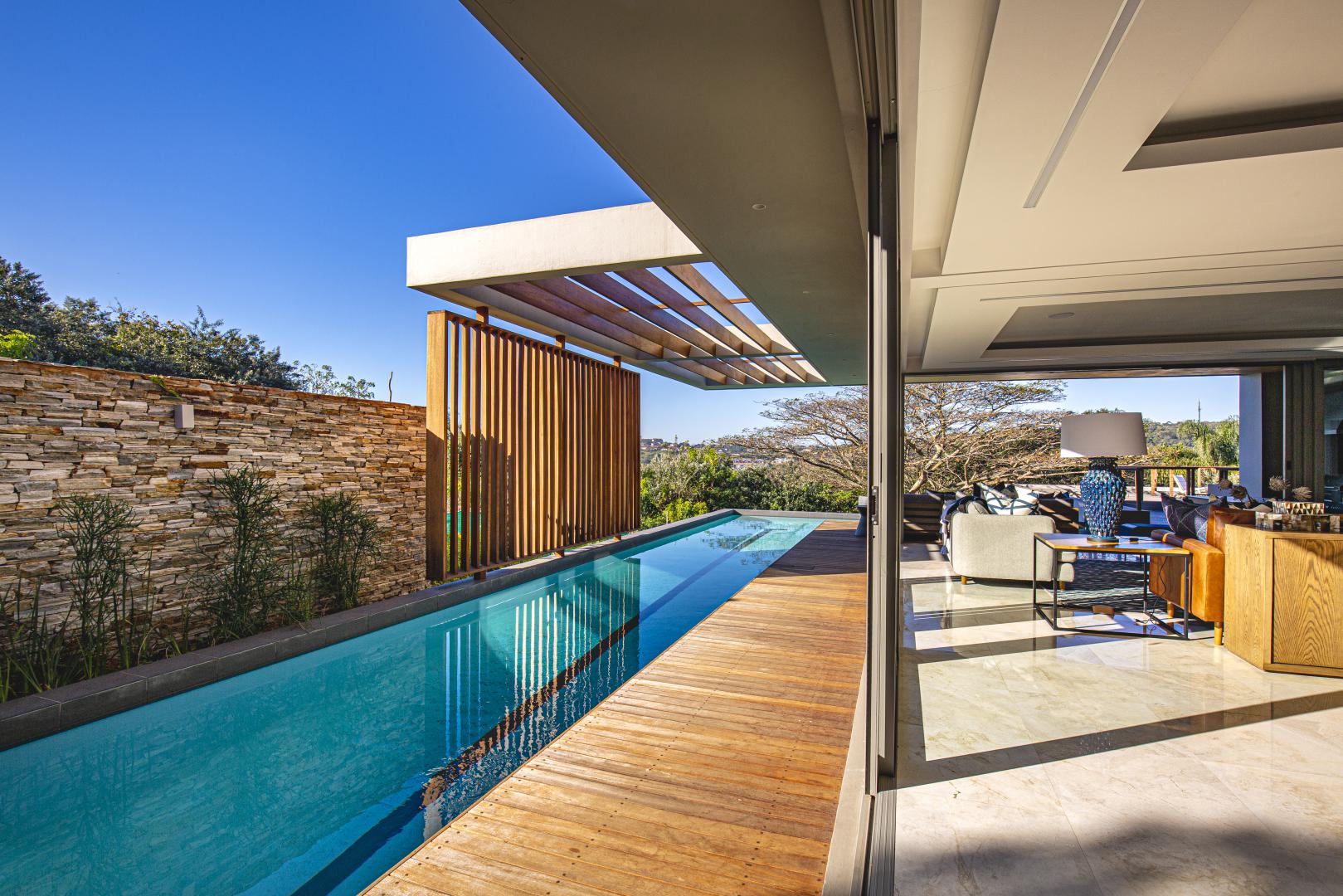
Approached centrally from outside the plot, the entry axis is set up on the side of the garden and leads directly into a deep verandah. This verandah is set around the entrance door, but can be accessed directly from the living and dining spaces. These ground level spaces blur the boundary between the swimming pool to the rear and the garden to the front, creating a continuous visual along the entire length of this private villa in Gurugam. Emphasizing this length is a rough hewn stone wall that wraps the building at the ground level.

On the first floor, the bedrooms look into the garden from two directions. On the second floor, the central space is planned as an entertainment den and opens up to the front and rear once more. A subterranean level is accessed from outside the house (although the internal elevator does
travel down for emergencies) and has the home office, storage and gym.

On the other hand, the exterior windows are chosen for their greater thermal and acoustic
performance, despite the inherently carbon intensive shipping process from Germany. The
kitchen and bathroom vanities are specified in stainless steel for longevity, and sensor based
lights are used throughout the home. Apart from the rough hewn boundary wall, the facade
bricks, roofing tiles and flooring stone are all selected from locally available options. One of
the key internal requirements of the practice is to deliver buildings that are built well and last a long time. To this end, the external materials chosen are chosen for their ability to age gracefully.


Far too often, zoning regulations are seen as a constraint on architectural virtuosity, an unwelcome leash on creativity. This private villa in Gurugam reimagines the mandated open spaces and appropriates them to its own requirements. The resulting garden is central to the clients experience of the house and not just from the deeply shaded exterior spaces, but from within the large glazing oil the interior spaces as well.

The 40/60 House – a private villa in Gurugam, is not just a residence; it’s an innovative response to zoning regulations. Amit Khanna Design Associates turns constraints into features, allocating a significant portion to a garden that introduces openness. The project showcases strategic design choices, emphasizing longevity and sustainability, proving that constraints can be opportunities for both aesthetic and functional excellence.
Would you like to publish your projects? Get Started Here
GALLERY